Will Your Couch Fit Through the Door?
The three couch numbers that decide it
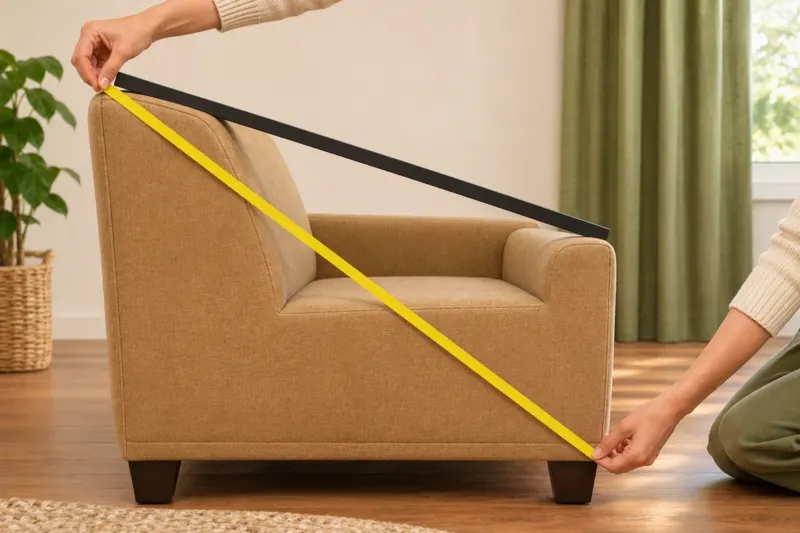
- Height (H): floor to the top of the back.
- Depth (D): front of the seat or arm to the back.
- Diagonal depth (DD): the shortest corner-to-corner measurement of the couch's side profile, back cushions removed. This is the number that tells you whether the couch can be tipped back and angled through a narrow opening.
Frontgate lists width, depth, height and diagonal depth for its furniture, and Crate & Barrel tells shoppers to check the product page for height, width and diagonal depth. Write the numbers down before you measure anything in your home.
Short answer
A couch can usually get through a doorway if the door's clear width is larger than at least one of its height, depth or diagonal depth, with a few inches to spare. Measure every opening on the route, not just the front door: hallways, turns, stairs and elevators are where deliveries get stuck.

How to measure your delivery path
- Pick the entrance. Room & Board suggests considering garage and patio doors, which may offer more clearance, and a service entrance in apartment buildings.
- Measure each doorway's clear width. With the door open all the way, measure from the face of the door to the door stop on the other side. That's the opening the couch actually has. Note knobs, hinges and trim that stick out.
- Measure each doorway's clear height, from the top of the threshold to the bottom of the stop.
- Measure entry clearance: the distance from the doorway to the opposite wall. Frontgate flags this because a long couch needs room to swing in.
- Measure hallways: width, height, and any low light fixtures. At each turn, Crate & Barrel says to measure the diagonal of the turn and make sure there's room to rotate and tilt.
- Measure stairs: width at the narrowest point including handrails, then ceiling height above the bottom step, any landing, and the top step. Room & Board also asks for landing width and depth, and the distance to the wall if the stairs end facing one.
- Measure the elevator, if there is one: door width and height, and interior height, width and depth. Room & Board adds a diagonal from the bottom center of the door opening to the back ceiling corner.
- Write it all down and circle the smallest number. The narrowest point on the whole route is the one that matters.
What US building code says about doors
| Door | Minimum clear width | Minimum clear height | Source |
|---|---|---|---|
| Required egress door of a dwelling (usually the main entry) | 32 in. (813 mm), door open 90°, face of door to stop | 78 in. (1981 mm), top of threshold to bottom of stop | 2021 International Residential Code, R311.2 |
| Other doors in the home | No minimum under this section | No minimum under this section | Same section: other doors "shall not be required to comply" |
What this means: the main entry of a home built under this code should give you at least 32 inches of clear width, but bedroom, bathroom and closet doors can be narrower. Local codes and older homes vary, so measure every door yourself.
Three ways a couch goes through a door
| Method | What has to be smaller than the door's clear width | What also has to fit |
|---|---|---|
| Carried level, back upright or on its side | Depth or height | The other of the two has to fit under the door's clear height |
| Tipped back and angled | Diagonal depth | The tipped profile has to clear the door's height (rarely the problem) |
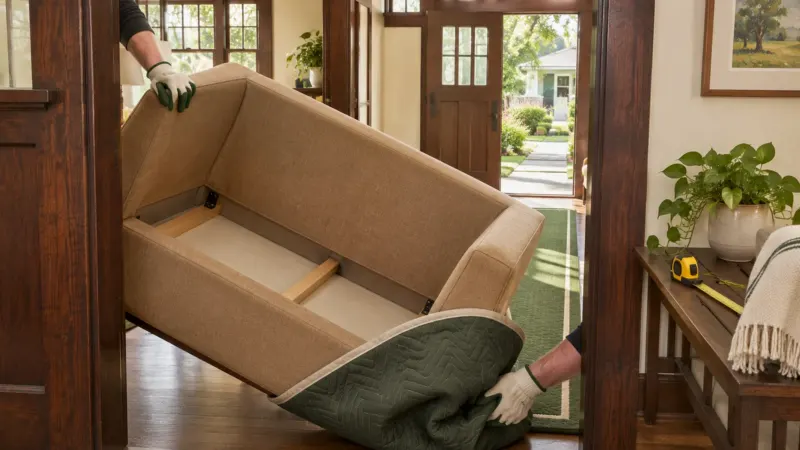
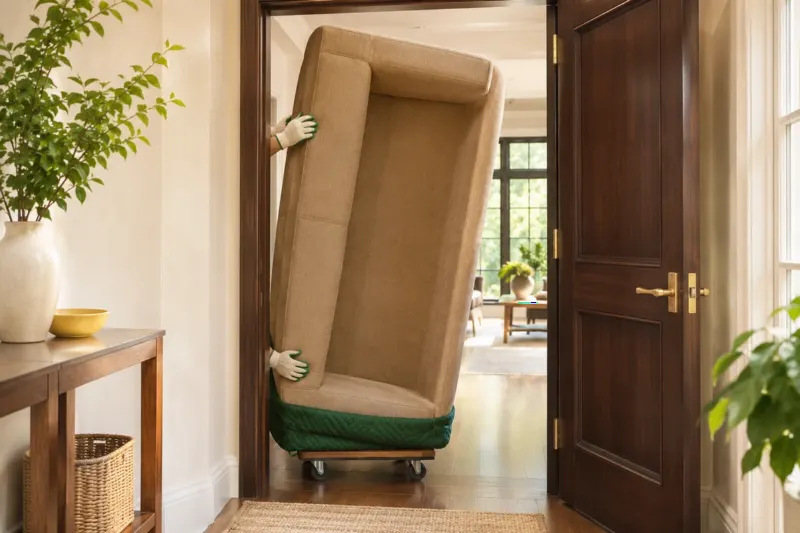
| Stood on end | Depth or height | The couch's full width (length) has to clear ceilings on both sides and swing through the door, which needs space in front of and behind it |
La-Z-Boy Southeast's guide sums up the core rule: the entryway width needs to be greater than at least one of the depth, height or diagonal depth. Frontgate adds that the margin should preferably be several inches.
Check your own numbers
How this check works
The calculator above tries the three ways a couch usually goes through a door, using your numbers plus a safety margin (2 inches unless you change it; Frontgate recommends "several inches"):
- Carried level: the depth fits within the door's clear width and the height fits under the door's clear height, or the other way round (height through the width, depth under the height).
- Tipped back and angled: the diagonal depth fits within the clear width. To stay on the safe side, the calculator also checks the full side profile (depth and height together) against the door's clear height, which overstates the real tipped size slightly.
- Stood on end: only possible if the couch's length also fits under the lower ceiling on either side of the door. Turning a long couch upright needs swing room no tape measure captures, so treat this result as "ask your delivery team," not a yes.
If none of the three works with your margin, the couch won't fit through that door as measured. See the options under "If it's tight."
Hallway turns: for a right-angle turn between two hallways of the same width, the longest perfectly thin object that can be carried around it flat is about 2.83 times the hallway width (Wolfram MathWorld, moving ladder problem). A couch has depth, so its real limit is shorter. Two 36-inch hallways give an upper bound of about 102 inches: a 90-inch couch isn't ruled out, but a 110-inch couch can't be carried flat around that corner.
Example: a 38-inch-deep couch and a 34-inch door
A couch is 38 in. deep, 34 in. high, with a 33-inch diagonal depth. The door's clear width is 34 in.
- Depth 38 > 34: can't go through level, back upright.
- Height 34 = 34: on its back, it touches both sides with no margin. Not realistic.
- Diagonal depth 33 < 34: tipped and angled, it clears by 1 inch. Possible, but tighter than Frontgate's "several inches."
Verdict: borderline. Look at a wider entrance, or ask whether the door can come off its hinges (see below). The arithmetic is ours; the dimensions are an example, not a specific product.
Who should measure twice
| Lower risk | Higher risk |
|---|---|
| Couches with removable legs or arms | Deep, high-back couches where every dimension is over 34 in. |
| Sectionals that arrive in separate pieces | One-piece sofas over 90 in. with a hallway turn on the route |
| Homes with a wide, straight path from the entrance | Walk-ups with a turning staircase or low ceiling at a landing |
| Ground-floor delivery through a patio or garage door | Elevator buildings where the cab is shallow |
Common questions
Will a 40-inch-wide sofa fit through a 36-inch door?
If "40 inches" is the depth, it won't go through level with the back upright. It can still fit if the height or the diagonal depth is under 36 inches, ideally with a few inches to spare. If 40 inches is the length, length isn't usually the limiting number at the door; check the hallway turns.
What size couch fits through a 29-, 30- or 32-inch door?
One whose height, depth or diagonal depth is smaller than the door's clear width, with a margin. Using a 2-inch margin, that means one of those three numbers at or under 27 inches for a 29-inch door, 28 inches for a 30-inch door, and 30 inches for a 32-inch door. This is our arithmetic from the rule above; measure the clear width with the door fully open, not the door slab.
Which comes first, length or width?
For the door, compare depth, height and diagonal depth with the door's width. Length (arm to arm) matters at hallway turns, stairs and elevators.
What if the couch doesn't fit through the door?
See the options below. If none work, a couch that arrives in pieces or with removable arms is the safer choice for that home.
If it's tight
- Take the door off its hinges. Room & Board says its delivery associates can usually remove and reattach interior doors for more space. Ask your delivery provider whether they do this.
- Use a different entrance. Garage, patio and service doors are often wider (Room & Board).
- Remove what you can. Room & Board lists light fixtures, handrails, wall art and similar obstacles; include them in your measurements if they can't come off.
- Ask before you order. Some retailers will check your measurements for you; Room & Board invites customers to send measurements before ordering.
Sources (accessed Nov. 3, 2026)
- International Code Council, 2021 International Residential Code, Chapter 3, Section R311.2 Egress door
- Room & Board, "Measuring for Furniture Delivery"
- Crate & Barrel, "How to Measure Furniture for Delivery"
- Frontgate Home + Style, "Learn How to Measure for a Hassle-Free Furniture Delivery"
- La-Z-Boy Southeast, "How to Measure Your Doorway for Furniture Deliveries"
- Levin Furniture, "Measuring Guide"
- Wolfram MathWorld, "Moving Ladder Problem"