What Size Mirror Goes Over a Vanity?
Short answer
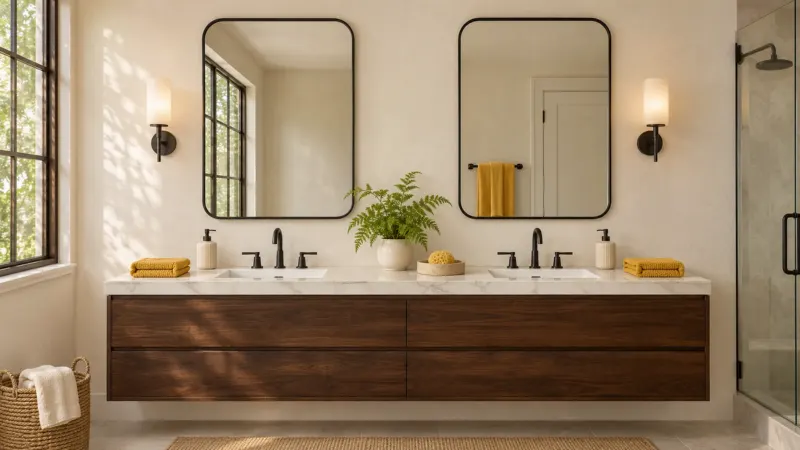
Go narrower than the vanity, never wider. Wayfair's guide puts the mirror 2 to 4 inches in from the vanity edge on each side, so a 36-inch vanity takes a 28- to 32-inch mirror. Designers quoted by Homes & Gardens go closer to full width, about 1 to 2 inches narrower in total. Both agree on one thing: the mirror shouldn't be wider than the counter below it.

Mirror width by vanity width
| Vanity width | One mirror, 2–4 in. in from each edge (Wayfair rule) | One mirror, 1–2 in. narrower overall (designers in Homes & Gardens) | Two mirrors, each (Wayfair spacing) |
|---|---|---|---|
| 24 in. | 16–20 in. | 22–23 in. | Not practical |
| 30 in. | 22–26 in. ✱ | 28–29 in. | Not practical |
| 36 in. | 28–32 in. ✱ | 34–35 in. | Not practical |
| 48 in. | 40–44 in. ✱ | 46–47 in. | 17–20 in. |
| 60 in. | 52–56 in. ✱ | 58–59 in. | 23–26 in. (Wayfair lists 22–26 in.) |
| 72 in. | 64–68 in. | 70–71 in. | 29–32 in. |
Table note: ✱ = figure printed in Wayfair's own FAQ. All other cells are our arithmetic using each source's rule. For two mirrors we used Wayfair's spacing: 2–4 inches from each outer edge and 4–6 inches between the mirrors. Wayfair also says a mirror should be at least as wide as the sink it's centered over, so on a narrow vanity with a wide sink, check that first.
One mirror or two?
| One wide mirror | Two mirrors | |
|---|---|---|
| Where it fits | Single vanities; double vanities if you want one clean line | Double vanities, one mirror centered over each sink |
| Spacing to plan | 2–4 in. in from each vanity edge | 2–4 in. from each outer edge, plus 4–6 in. between mirrors |
| Combined width | Narrower than the vanity | Combined width still narrower than the vanity |
| Watch out for | Sconces beside it eat into the width | Sinks that aren't evenly spaced make centering hard |
Source: Wayfair's vanity mirror guide. Designer Oana Sandu, quoted by Homes & Gardens, prefers a mirror over each sink on a double vanity for balance.
How to measure before you buy
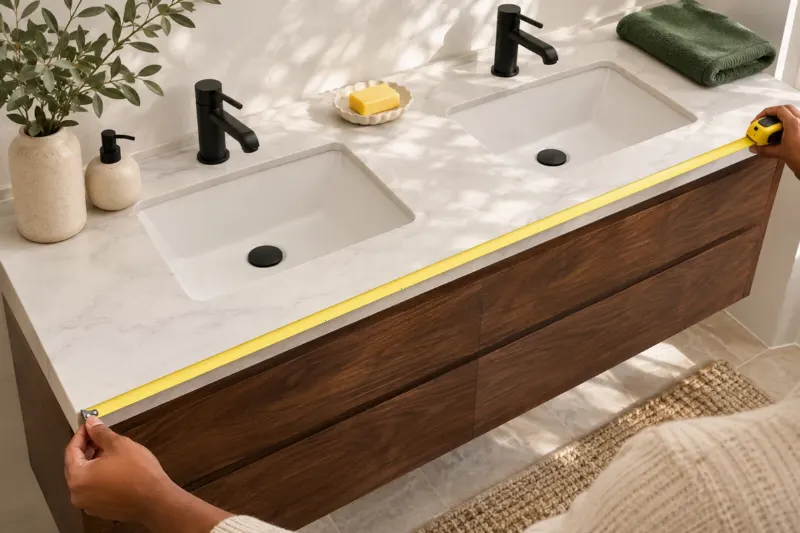
- Measure the countertop width from one outside edge to the other. Use the countertop, not the cabinet below, if the top overhangs.
- Mark each sink's center line on the wall with painter's tape. The mirror (or each mirror) centers on this line, not on the vanity, if the sink is off-center.
- Measure from the countertop to the top of the backsplash and the top of the faucet. The mirror's bottom edge goes above whichever is higher.
- Measure from the countertop to the ceiling, and note any light fixture or electrical box above or beside the mirror area.
- Tape the mirror's outline on the wall at the size you're considering and look at it from the doorway and from where you'd stand to use it.
How high to hang it
- Bottom edge: 5 to 10 inches above the countertop, per Wayfair, to keep faucet splashes off the glass. Designer Emma Merry, quoted by Homes & Gardens, hangs mirrors about 4 inches above the top of the backsplash.
- Center: around eye level, about 60 to 65 inches from the floor, per Wayfair.
- Top edge: at least 5 to 10 inches below the ceiling, per Wayfair.
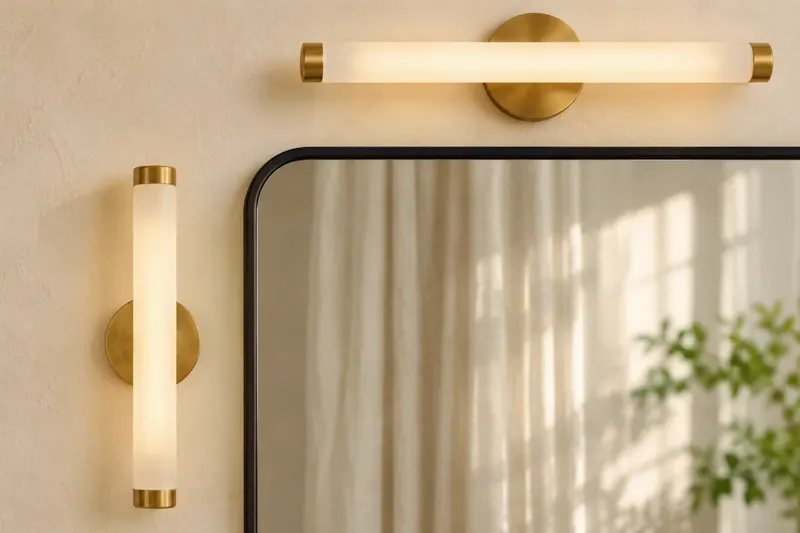
- Light above the mirror: leave 3 to 6 inches between the mirror top and the fixture, per Wayfair. Sconces beside it: leave 2 to 6 inches from the mirror edge.
When the height rules collide
The bottom-edge rule and the eye-level rule don't always fit together, especially with a short mirror. Here's the math for a countertop that sits 34 inches off the floor (measure yours; it's the only input that matters):
- Bottom edge at 5–10 inches above the counter = 39 to 44 inches from the floor.
- To center the mirror at 60–65 inches with the bottom at 44 inches, the mirror has to be at least 32 inches tall.
- A 30-inch-tall mirror, the typical size Homes & Gardens mentions, centers at 59 inches even when hung at the top of the range, about an inch below Wayfair's eye-level band.
This is our arithmetic. In practice, if your household includes people of very different heights, hang the bottom edge where it clears the faucet, then check the view for the shortest and tallest regular user before drilling.
Which approach suits your bathroom
| Go with Wayfair's narrower rule if… | Go closer to full width if… |
|---|---|
| Sconces will flank the mirror and need wall space | There are no lights on either side of the mirror |
| The vanity has open space on both ends you want to show | You want the mirror to read as part of the vanity |
| You're hanging two mirrors over a double vanity | You're hanging one mirror across a double vanity |
Homes & Gardens' designers note that when wall lights sit on both sides, the mirror is generally slimmer, which lines up with the left column.
Common questions
Can you put a 30-inch mirror over a 30-inch vanity?
Neither source we checked recommends going full width. Wayfair's guide puts a 30-inch vanity with a 22- to 26-inch mirror; the Homes & Gardens rule would land at 28 to 29 inches.
Is a 24-inch mirror too small for a 36-inch vanity?
It's below both ranges (28–32 inches by Wayfair's rule, 34–35 by the designers' rule), so it will look small. It's not wrong if it's at least as wide as the sink, which is Wayfair's minimum.
What size mirrors for a 60-inch double vanity?
Either one mirror of 52 to 56 inches, or two mirrors of 22 to 26 inches each, per Wayfair's FAQ.
What is the standard mirror size for a bathroom?
There isn't one standard size. Mirrors are sold in many widths, and the right one depends on the vanity under it. By Wayfair's 2-to-4-inch rule, a 24-inch vanity takes a mirror about 16 to 20 inches wide, a 30-inch vanity 22 to 26 inches, a 36-inch vanity 28 to 32 inches, and a 48-inch vanity 40 to 44 inches. Measure your vanity first, then shop by width.
Should a bathroom mirror be bigger or smaller than the vanity?
Smaller. Wayfair says it should never be wider than the vanity, and Homes & Gardens gives the same rule.
Before you drill
- Check the mirror's weight and use the mounting hardware and wall anchors the mirror maker specifies for your wall type.
- Confirm the frame is meant for bathroom humidity. Homes & Gardens' designers flag steam and splash damage to unsuitable frames.
- Renting? Read your lease before drilling into tile or walls.