Glass Pantry Jars: Sizes, Seals and What to Buy
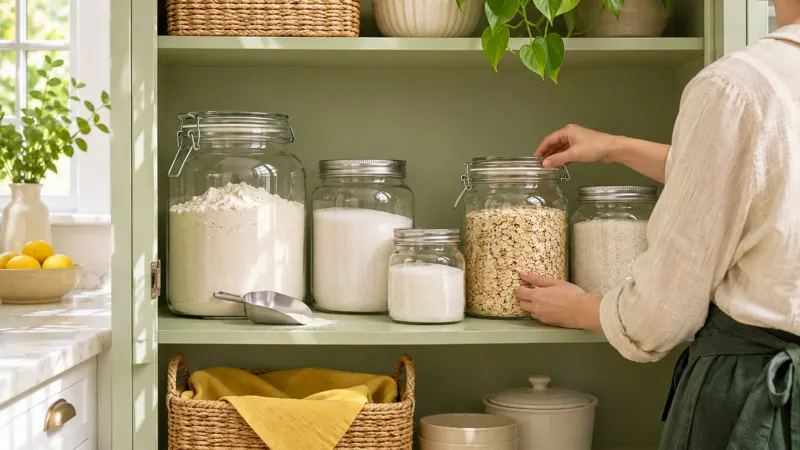
A 5-pound bag of all-purpose flour takes up about 151 fluid ounces. A 1-gallon jar holds 128. That gap is why so many pantry makeovers end with half a bag of flour sitting next to a pretty, full jar. Sizing a jar is easy once you convert the bag's weight to volume, and the conversion is the part nobody prints on the label.
Short answer
Size the jar to the bag you usually buy, then go one size up so there's room to scoop. Flour and powdered sugar are bulky for their weight; sugar and rice are dense. For keeping pests out, the lid matters more than the jar: pick a lid that closes tightly, with a gasket or a screw thread.

How much room your pantry staples need
| Ingredient | Volume per pound | Common bag | Volume of that bag | Jar size to look for |
|---|---|---|---|---|
| All-purpose flour | 3.8 cups (30 fl oz) | 5 lb | about 151 fl oz | More than 1 gallon; about 1.5 gallons (192 fl oz), or split between a gallon and a quart |
| All-purpose flour | 3.8 cups (30 fl oz) | 2 lb | about 60 fl oz | Larger than a half gallon (64 fl oz), which would be nearly full |
| Granulated sugar | 2.3 cups (18 fl oz) | 4 lb | about 73 fl oz | About 3 quarts (96 fl oz) or 1 gallon |
| Brown sugar, packed | 2.1 cups (17 fl oz) | 2 lb | about 34 fl oz | Larger than a quart (32 fl oz); a half gallon leaves room |
| Powdered sugar | 4.0 cups (32 fl oz) | 2 lb | about 64 fl oz | Larger than a half gallon |
| Long-grain white rice, dry | 2.3 cups (18 fl oz) | 2 lb | about 37 fl oz | Half gallon (64 fl oz) |
| Long-grain white rice, dry | 2.3 cups (18 fl oz) | 5 lb | about 92 fl oz | 1 gallon (128 fl oz) |
| Old-fashioned oats | 5.1 cups (41 fl oz) | 1 lb | about 41 fl oz | Half gallon (64 fl oz) |
Table note: our arithmetic. Cup weights come from King Arthur Baking's ingredient weight chart (all-purpose flour 120 g per cup, granulated sugar 198 g, packed brown sugar 213 g, powdered sugar 113 g, dry long-grain rice 99 g per half cup, old-fashioned oats 89 g). Conversions use 1 lb = 453.6 g and 1 cup = 8 fl oz. How tightly contents settle varies, so treat these as planning numbers and leave headroom.
Jar sizes, decoded
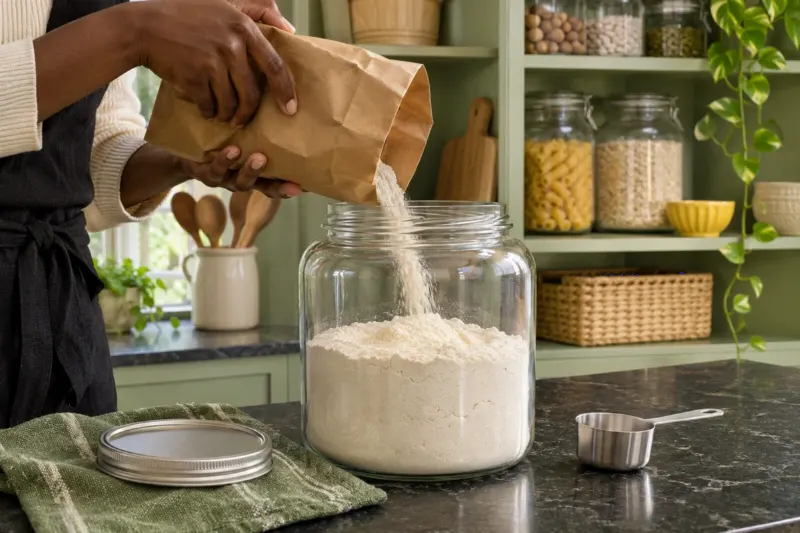
- Pint = 16 fl oz. Quart = 32 fl oz. These are the standard Ball mason jar sizes.
- Half gallon = 64 fl oz. Gallon = 128 fl oz. A gallon is about 3.79 liters and a quart about 0.95 liters, per NIST.
- Check the label unit. Some jars list capacity in milliliters or liters. Divide milliliters by 29.57 to get fluid ounces (NIST).
- Mouth width matters for scooping. Ball sells the same sizes in regular- and wide-mouth versions. For flour and sugar, you'll want a mouth wider than your measuring cup.
How to size your jars
- Measure the shelf's clear height. Include room to lift the lid off, or for a hinged clamp lid, room for it to swing open.
- Measure the shelf depth. Round jars in a deep cabinet can hide the back row; you may prefer fewer, larger jars.
- Write down the bag weight you usually buy for each staple.
- Find its volume in the table above, or multiply the pounds by the fl-oz-per-pound figure.
- Choose the next jar size up so you're not filling to the rim.
- Measure across your measuring cup or scoop and compare it with the jar's mouth opening, if the listing gives it.
Lid and seal types
| Lid type | How it seals | Good for | Watch out for |
|---|---|---|---|
| Screw-on lid (mason style) | Thread pulls the lid down onto the rim | Everyday staples; easy to replace lids | Takes two hands; small mouths are hard to scoop from |
| Clamp (bail) lid with rubber gasket | Wire clamp presses a gasket against the rim | Flour, sugar, anything you open often | Gaskets wear out; the hinged lid needs swing room above |
| Push-on lid with silicone ring | Friction fit of a ring inside the rim | Quick one-hand access on open shelves | Fit can loosen over time; check the ring regularly |
| Loose lid, no gasket | Rests on the rim | Display, or things you use up in days | Not a tight fit, so it doesn't keep pests out |
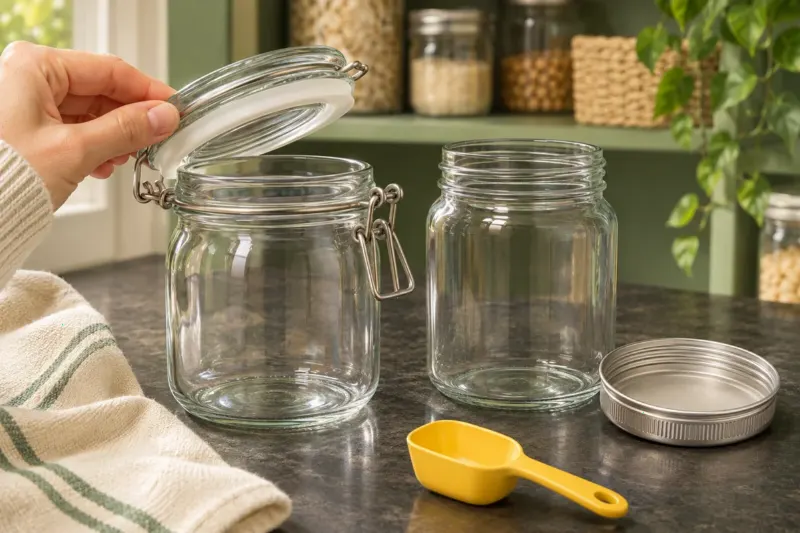
Keeping pantry pests out
From UC Statewide Integrated Pest Management (University of California):
- Use containers with tight-fitting lids. Plastic bags aren't adequate.
- Wash old containers before refilling. Leftover food can carry eggs into the new batch.
- Freeze what you rarely use. UC IPM suggests keeping infrequently used flours, grains and spices in the freezer if possible.
- Know the signs. Webbing in package folds or tiny holes in a package point to an infestation.
- After an infestation, store susceptible food in airtight containers or in the fridge or freezer for several months; some pests live for weeks without food.
Glass or plastic for the pantry?
| Glass | Plastic | |
|---|---|---|
| See what's inside | Yes | Clear plastics, yes |
| Weight to lift from a high shelf | Heavier, especially at gallon size | Lighter |
| If it's dropped | Can break | Usually survives |
| Pest protection | Depends on the lid | Depends on the lid |
For keeping pests out, UC IPM's advice is about tight-fitting lids, not the material. Choose glass for shelves at counter height and below, and think twice about large glass jars on a high shelf.
Are glass pantry jars right for you?
| Good fit | Probably not |
|---|---|
| You buy staples in consistent bag sizes | Bag sizes change every trip, so jars are always too big or too small |
| Your pantry shelves are at or below shoulder height | Storage is mostly overhead, where heavy glass is awkward to lift |
| You like seeing what's running low | Young kids reach the shelf and breakage is a concern |
| You've had pantry moths or beetles and want tight lids | You only need short-term storage for things used up within days |
Common questions
What size jar do I need for a 5-pound bag of flour?
About 151 fluid ounces of space, by our arithmetic from King Arthur's 120 grams per cup. That's more than a 1-gallon jar (128 fl oz), so look for about 1.5 gallons or split it between two jars.
Do glass jars keep pantry moths out?
The lid is what counts. UC IPM recommends containers with tight-fitting lids and says plastic bags aren't enough.
Is a quart jar big enough for a 2-pound bag of rice?
Not quite. Two pounds of dry long-grain rice comes to about 37 fluid ounces; a quart holds 32.
What are the downsides of glass containers?
Weight and breakage, mainly. Large glass jars are heavy when full, which matters on high shelves.