
Magnetic Fridge Racks: Will Your Fridge Hold One?
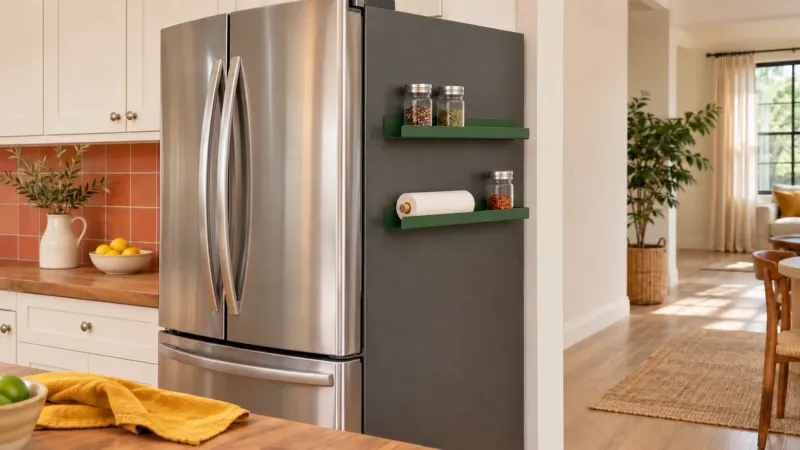
Grab any fridge magnet from the junk drawer and walk over to the spot where you picture the rack. That ten-second test answers the first question better than any product listing can. The second question, how much the rack will actually hold, takes a little more thought, because a magnet's strength rating isn't measured the way a fridge rack gets used.
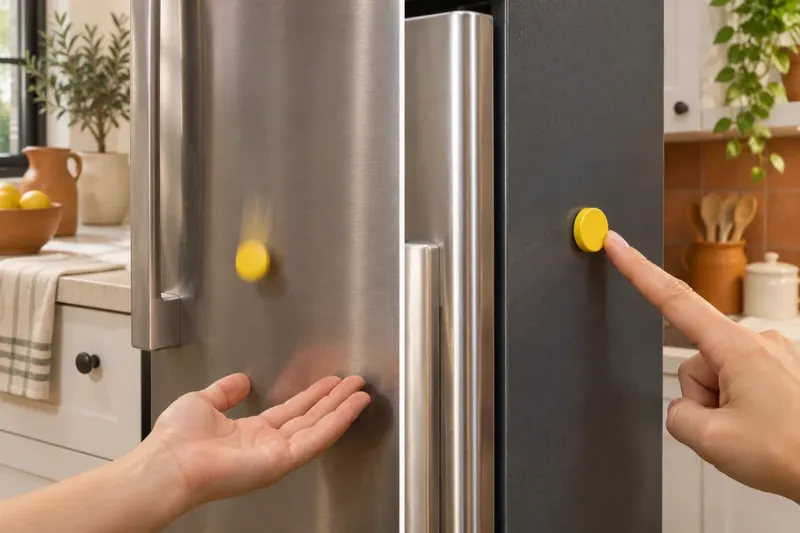
The 10-second test
- Pick the exact spot. Side panel or door, and roughly how high.
- Stick a plain fridge magnet there. If it falls, a magnetic rack won't work on that surface.
- If it holds, slide it with one finger. A magnet that skids down easily on a slick finish is a warning sign for anything heavy.
- Repeat on the other side panel and the door. Different surfaces on the same fridge can behave differently.
- Put your palm flat on the side panel for a minute. Note whether it's noticeably warm. (More on that below.)
Short answer
Some stainless steel holds magnets and some doesn't, so test your fridge, don't assume. If a magnet sticks, the next limit is weight: on a vertical surface a magnet holds only a fraction of its rated pull force. Keep loads light, put heavier items low, and check whether the side panel runs warm before you store anything there.

Why some stainless fridges won't hold a magnet
- Two main families of stainless steel. Ferritic stainless steels are generally magnetic; austenitic stainless steels usually are not, according to UC Berkeley materials scientist Thomas Devine, writing in Scientific American.
- The common grade is usually the non-magnetic one. Type 304, about 18% chromium and 8% nickel, keeps a non-magnetic crystal structure at room temperature, he explains.
- Bending can change it. If 304 is bent or deformed, part of it can turn magnetic, which is why a magnet may grab in one spot and not another.
- So test, don't guess. You can't tell the grade by looking at a fridge, which is why the magnet test above is the reliable check.
What "holds X lb" really means
A magnet's listed pull force is measured by pulling it straight off a thick, flat steel plate. A fridge rack hangs on a vertical surface, where gravity tries to slide it down instead. K&J Magnetics, a magnet seller that publishes its test data, says to plan on only 10% to 25% of the listed pull force when a magnet is loaded this way. In its own test on a painted steel fridge, a magnet rated at 6.44 lb slid with only about 0.24 lb of force, around 4%.
| Rack plus contents | Rated pull force needed at 25% grip | At 10% grip | At 4% (slick painted fridge) |
|---|---|---|---|
| 2 lb | 8 lb | 20 lb | 50 lb |
| 5 lb | 20 lb | 50 lb | 125 lb |
| 10 lb | 40 lb | 100 lb | 250 lb |
Table note: our arithmetic, using the K&J percentages. Real results depend on the finish, the magnet's coating and how flat the rack sits. When a listing gives a weight limit, look for whether it was tested hanging on a vertical surface. If it only quotes magnet pull force, divide it down before you load the rack.
The warm side panel
- It's normal. Whirlpool says many models have condenser loops built into the cabinet walls and front frame, so a slight to moderately warm feel on the sides often means the system is working as designed.
- It gets warmer in a hot kitchen. Whirlpool notes the compressor runs longer in hot rooms, which moves more heat through the cabinet.
- Samsung describes the same thing. Its support page (for models sold in Canada) says heat-dissipation pipes run along the outer walls.
- What it means for a rack: if the panel feels warm, it's a warm spot. Store things there that you'd be fine keeping on an open counter.
Clearance around the fridge
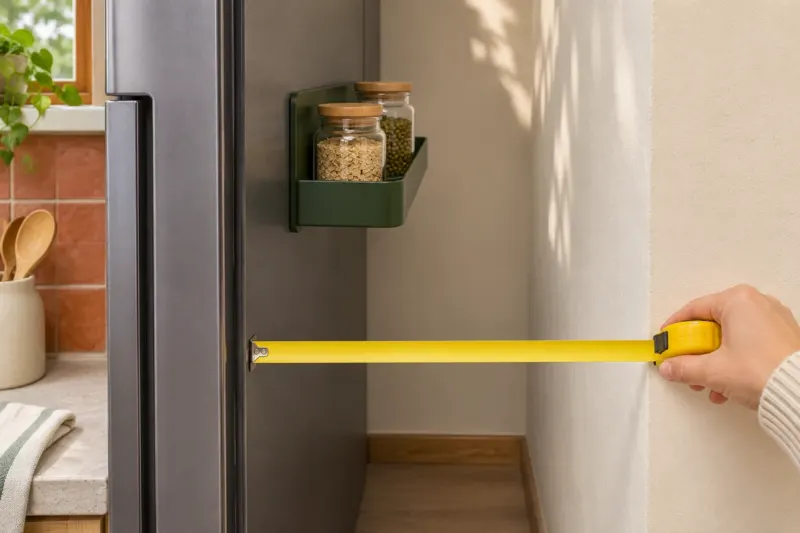
- Samsung's Canadian support page asks for at least 5 cm (about 2 in.) of space at the sides and back and 2.5 cm (about 1 in.) above its refrigerators for air circulation.
- Requirements differ by model. Check your fridge's manual for its numbers.
- If the fridge sits in a tight cabinet opening, a rack on that side may end up in the space the manual asks you to keep clear. Measure the gap between the fridge side and the wall or cabinet, then compare it with the rack's depth plus whatever you'll put on it.
Is a magnetic fridge rack right for you?
| Good fit | Skip it or choose another option |
|---|---|
| A magnet sticks firmly and doesn't slide easily at your chosen spot | The magnet falls off, or only the door holds and you want the side |
| Light, everyday items: spice jars, foil and wrap, a paper towel roll | Heavy bottles, glass jars in quantity, cast iron |
| The side panel is exposed with open space beside it | The fridge is boxed in by cabinets or a wall with little gap |
| You can keep the rack's load low and spread across its full face | You'd want to load it to the listed maximum |
Common questions
Why don't magnets stick to my stainless steel fridge?
Many stainless steels, including the common Type 304, are austenitic, a structure that usually isn't magnetic. The door may use a different material or finish from the sides, so test both.
Can I make my fridge magnetic?
People sometimes attach a thin steel sheet with adhesive, but adhesives can mark a finish and are hard to remove, which matters on a rented or new fridge. A wall-mounted or freestanding rack beside the fridge avoids the question.
Are magnetic spice racks a good idea?
They work well when the surface holds a magnet firmly, the load is light, and the spot isn't warm. If any of those three fail, a shelf or drawer organizer is the safer choice.
Will a magnetic rack scratch my fridge?
Any rack that slides can scuff a finish. Lifting it off rather than dragging it reduces the risk; some racks have a soft backing, which you can check in the listing.
Sources (accessed Nov. 3, 2026)
- Scientific American, "Why don't magnets work on some stainless steels?" (answer by Thomas Devine, UC Berkeley)
- K&J Magnetics, "How Much Will a Magnet Hold?"
- K&J Magnetics, "Turning Rocks and Crystals into Fridge Magnets" (painted-fridge slide test)
- Whirlpool Product Help, "Why Does the Outside of the Cabinet Feel Warm"
- Samsung Canada, "Why the sides of your Samsung refrigerator get hot"