Curtain Length Guide: 63, 84, 96 or 108 Inches?
Short answer
Ready-made curtains come in 63, 84, 96, 108 and 120 inches (The Spruce, Better Homes & Gardens); some brands sell 95 instead of 96 (Two Pages). The right one is the distance from your rod to the floor, so decide the rod height first. In a room with an 8-foot ceiling, a rod a few inches above a typical window usually calls for 84 inches, and a rod at the ceiling calls for 96. Use 63 inches only for sill-length or café curtains. If you're between two sizes, go longer: The Spruce and BHG both lean toward slightly too long over too short.
Three decisions, in this order
- Rod height. This sets the length. The sources disagree (table below), so pick a rule, then measure from that point to the floor.
- Finished length. Float, kiss, break or puddle. The Spruce: float = subtract 3/8 to 1/2 inch; kiss = the exact rod-to-floor distance; break = add 1/2 to 1 inch.
- Width. Rod past the window on both sides, and panels that add up to about twice the width (BHG, The Spruce).
More Home & Decor guides cover the furniture in front of the window; search for one, or browse all guides.
Standard curtain lengths and where they end
| Length | Typical use | What the sources say |
|---|---|---|
| 63 in. | Sill or café length: kitchens, bathrooms, small windows | The Spruce: shorter lengths are for café and above-the-sink curtains. Two Pages: smaller windows where floor length is impractical |
| 84 in. | Floor length when the rod sits close to the window in a standard-height room | Two Pages: common for standard-height rooms with the rod near the frame |
| 95 or 96 in. | Floor length with a higher rod, or rod at an 8-foot ceiling | Two Pages: for when 84 in. falls short; brands sell 95 or 96 |
| 108 in. | High ceilings or taller windows | Two Pages: higher ceilings or a longer drape |
| 120 in. | Very tall windows, ceiling-mounted rods, puddling | Two Pages, The Spruce, BHG |
Below the sill: Two Pages defines apron length as ending 4 to 6 inches below the window sill.
Where to hang the rod: three rules
| Source | Rod height | Rod width |
|---|---|---|
| Better Homes & Gardens | Typically 4–6 in. above the window frame, or just below the ceiling to make windows look taller | 8–12 in. wider than the window, 4–6 in. each side |
| Bob Vila | About 6 in. above the frame with an 8-ft ceiling; higher if there's less than 12 in. between window and ceiling. With 10-ft+ ceilings, within 8 in. of the frame | 3–6 in. or more past each side; up to a third of the window width in total |
| The Spruce | To the ceiling with 8-ft ceilings (just below crown molding); 12–14 in. above the window with high ceilings | Add 16–24 in. to the window width, including trim |
What this means: the three rules can put the rod as much as 10 inches apart on the same wall, and every inch changes the curtain length you need. That's why you measure after choosing the rod height, not before.
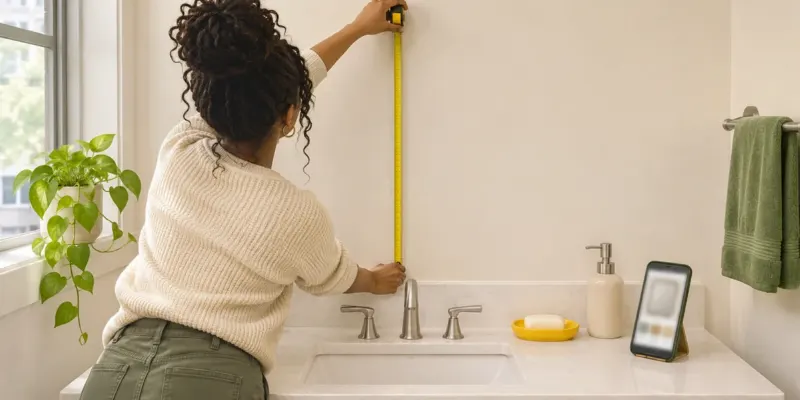
How to measure for curtains
- Measure the window width, including trim (The Spruce). For a sliding patio door, measure the opening the same way; our door widths guide lists typical sizes.
- Choose the rod width: the window plus your chosen extension on each side (table above).
- Mark the rod height using one of the three rules.
- Measure from that mark to the floor. For grommet and tab tops, measure from the top of the grommet or tab; for pleats on rings, from the underside of the ring; a rod pocket needs no adjustment (The Spruce).
- Adjust for the look you want: subtract 3/8 to 1/2 inch to float, or add 1/2 to 1 inch for a break (The Spruce). Bob Vila: 1 to 3 inches more for a light puddle.
- Choose panel width: add up the panels so they're about 2 times the window width (BHG; The Spruce says at least 2 times). Bob Vila says 2 to 2.5 times; Two Pages gives 1.5 to 2 times the rod width for standard curtains, 2 times for sheers and 1.5 times for blackout panels. Standard US panels are 48 inches wide, with 24 and 36 also common (The Spruce).
- Buy the next length up if you're between sizes (BHG), and wash and iron before you measure finished panels, since they may shrink (BHG).
Example: 63, 84 or 96 under an 8-foot ceiling
The ceiling is 96 in. The top of the window frame is 80 in. off the floor, the sill is 36 in., and the window is 54 in. wide (example measurements).
- BHG rule, rod 4 in. above: rod at 84 in. An 84-inch curtain kisses the floor. At 6 in. above (86 in.), an 84 would hang 2 in. short; The Spruce's designers say panels a few inches off the floor look like a mistake.
- Bob Vila rule, about 6 in. above: rod at 86 in. 84 is 2 in. short, 96 puddles about 10 in. Hang the rod at 84 instead, or have 96s hemmed.
- The Spruce rule, rod at the ceiling: rod at about 96 in. A 96-inch curtain kisses the floor.
- 63 inches: from a rod at 84 in., it ends 21 in. off the floor: 15 in. below the sill but nowhere near the floor. For a 63 to end at the sill, the rod would need to be at 99 in., above this ceiling.
- Width: rod 54 + 12 = 66 in. (BHG's upper end). Twice the window is 108 in. of fabric. Two 48-inch panels give 96 in. (about 1.8 times); three give 144 in.
Verdict: 84 inches with the rod about 4 inches above the frame, or 96 inches with the rod at the ceiling. 63 doesn't work here. All arithmetic is ours. Like all our guides, this one covers sizes, not specific products.
Which length suits your room
| Room or window | Length to start from |
|---|---|
| Kitchen window over a sink or counter | 63 in., sill or apron length (Two Pages: sill length in kitchens) |
| Radiator, deep sill or sofa under the window | Sill length, or just above the obstruction (Bob Vila) |
| Living room, dining room or bedroom, 8-ft ceiling | 84 in. with the rod near the frame; 96 in. with the rod at the ceiling |
| 9-ft ceiling or higher rod | 96 or 108 in.; measure, since rod height decides it |
| 10-ft ceiling or tall windows | 108 or 120 in. (Two Pages) |
| Homes with small children or older adults | Float or kiss; The Spruce says puddled curtains can be a tripping hazard |
Place the big furniture before you choose a length, since Bob Vila's sill-length advice depends on what sits under the window. If the sofa hasn't been delivered yet, check that it fits through the door first.
Common questions
Should I get 63 or 84 inch curtains?
Measure from where the rod will go to where you want the curtain to end. If the answer is the floor, 63 is almost always too short: from a rod 84 inches up, it stops 21 inches off the floor (our arithmetic). Choose 63 only for sill-length or café curtains, as The Spruce suggests; choose 84 when your rod sits about 84 inches high.
How long should curtains be below the window sill?
For apron length, 4 to 6 inches below the sill (Two Pages). Sill-length curtains end at the sill itself. Floor-length curtains end just above or at the floor.
Is it better to have curtains that are too long or too short?
Too long. The Spruce says longer is generally better and can make a room look taller; BHG says to lean toward a slightly longer size. Short can work if the hem lines up with another line in the room, such as the sill (The Spruce).
How high above the window should a curtain rod be?
BHG says 4 to 6 inches above the frame. Bob Vila says about 6 inches with an 8-foot ceiling. The Spruce says go to the ceiling with 8-foot ceilings, or 12 to 14 inches above the window with high ceilings.
How wide should curtains be?
Together, about twice the window width (BHG, The Spruce), or 2 to 2.5 times (Bob Vila). Two Pages measures against the rod instead: 1.5 to 2 times its width for standard curtains.
How long are 84-inch curtains on an 8-foot ceiling?
They reach the floor when the rod is about 84 inches up, which is 12 inches below an 8-foot ceiling (our arithmetic). With the rod at the ceiling, you need 96s.
An unusual window? Email us the measurements.
Before you order curtains
Six checks before you buy:
- Rod height chosen and marked, not guessed.
- Rod-to-floor distance measured at both ends of the window; floors aren't always level.
- Header type accounted for: grommet, tab, ring or rod pocket.
- Panel widths add up to about 2 times the window.
- Between sizes? Order the longer one and hem it.
- Brackets on studs or wall anchors; BHG puts one at least every 3 feet and a center bracket on windows 72 inches wide or more.