ORION Solar Path Light: Soft Marker Light That Won't Bother the Neighbours
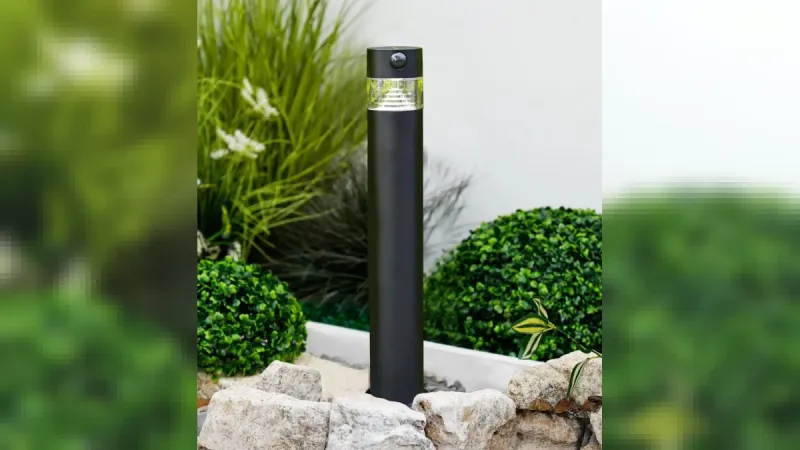
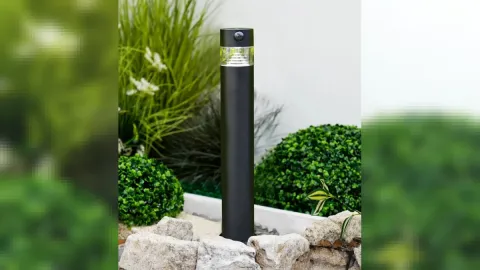
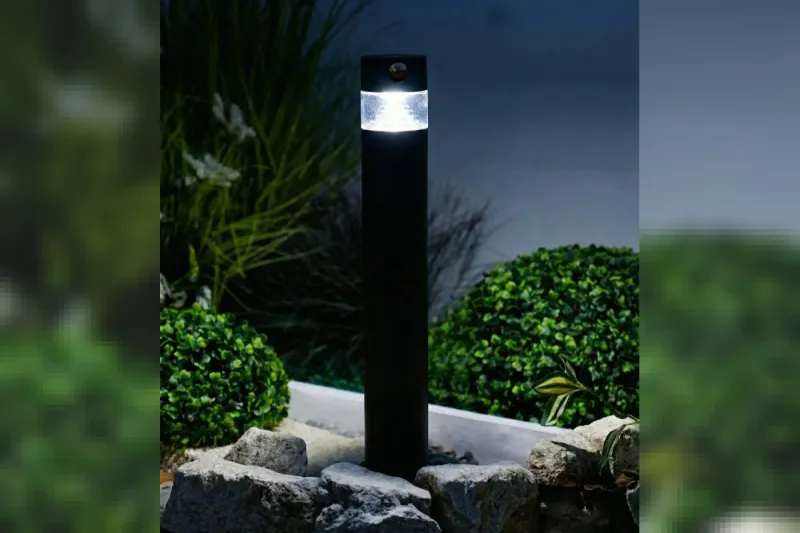
Not every garden light needs to be bright. In a terraced row or a village where houses face each other, a 1000-lumen burst every time a cat crosses the lawn is how disputes start. ORION is the opposite kind of light: a slim 50 cm post that glows at 70 lumens and steps up to 150 when someone walks by. It marks the path; it does not floodlight it.
Short answer
Choose ORION when you want to mark the edge of a path or lawn with a gentle, 360° glow and keep light out of the neighbours' windows. It is the cheapest light here at €37.90 (lumihome.com, Nov. 5, 2026). Be realistic about winter: its 0.5 W panel collects very little in a northern December, so expect an hour or two of glow, not a full night.
Where it ships: Lumihome delivers to France, Belgium, Germany, Spain, Italy, the Netherlands and Portugal only. Not the UK, Ireland, Switzerland or anywhere outside the EU (as listed on lumihome.com on Nov. 5, 2026; check their site on the day).

What a 0.5 W panel can do
The chart below uses the EU Joint Research Centre's PVGIS data. On a flat panel, a December day in Paris delivers about 16% of the solar energy of a June day. Brussels, Amsterdam and Berlin get 10–13%. Lisbon, Madrid and Rome keep 25–29%. When a product page says "recharges in 6 to 8 hours", it means a sunny day, not a northern winter.
ORION is one of the few solar lights that publishes its panel size, so we can do the arithmetic. A panel rated 0.5 W delivers about 0.5 Wh for every kWh/m² of sunlight. Allow roughly a third for losses (angle, dust, heat, charging), then compare with the battery: a 3.2 V, 600 mAh LiFePO4 cell holds about 1.9 Wh, and the light runs up to 8 hours on the low setting, so low uses roughly 0.24 W.
- Paris in December: about 0.9 kWh/m² a day, so about 0.3 Wh into the battery: roughly 1 to 1.5 hours of the low glow.
- Lisbon or Madrid in December: about 2.1 kWh/m², so about 0.7 Wh: roughly 3 hours.
- Anywhere in June: more than enough to fill the battery and run the full 8 hours.
These figures assume a well-placed light with open sky.
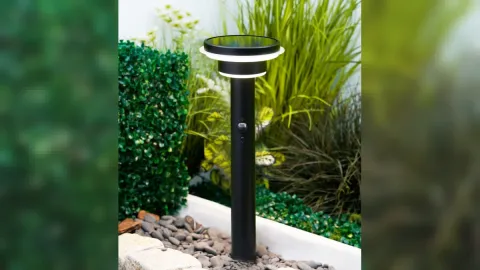
ORION against a brighter solar bollard
| ORION | GENOVA | |
|---|---|---|
| Light | 70 lumens, 150 on motion, all-round 360° | 100 to 1000 lumens, 120° downward |
| Height | 50 cm, 7.6 cm wide | 45 cm, 17.5 cm wide |
| Battery | LiFePO4 3.2 V 600 mAh | Lithium-ion 3.7 V 2200 mAh |
| Mounting | 16 cm ground spike | Base plate and screws |
| Price (Nov. 5, 2026) | €37.90 | €64.90 |
The LiFePO4 chemistry is a quiet advantage: it generally tolerates more charge cycles than standard lithium-ion, which matters for a light that cycles every single night. Like any lithium cell, it should not be charged below freezing.
Setting out a row
- Use it as a marker, not a lamp. Space posts 1.5 to 2.5 m apart along a curve or lawn edge; at 70 lumens each one lights a small pool.
- Push the spike into soaked soil. Water the spot first and push by hand on the spike, not the slim post.
- Give each one open sky. One shaded post in a row will be the first to go dark every evening.
- Keep the 8 m sensor away from the street if passers-by would trigger it.
Who it suits, who it doesn't
Good fit: small gardens with close neighbours; lawn and bed edges; holiday homes in Portugal and Spain where winter sun is decent; anyone who finds bright LED garden lights harsh.
Pick something else if: you need to see steps clearly (go brighter, like GENOVA); you live in the Benelux or northern Germany and want light all evening in winter (wire it: Pyramide 1500); or the ground is all paving (it mounts on a spike).
Questions
Is 150 lumens enough to walk by?
Enough to see where the path goes, not enough to read a step edge clearly. Use it on level paths.
Why does one post go dark before the others?
Usually shade or a dirty panel. Clean the top and check what shades it at midday.
Are the LEDs replaceable?
No. The eight LEDs are built in; the fixture has a two-year guarantee, battery excluded.
Does it ship to Switzerland?
No. Only France, Belgium, Germany, Spain, Italy, the Netherlands and Portugal.
Specs and price checked on lumihome.com on Nov. 5, 2026. Run-time figures are our estimates from EU PVGIS data and the published panel and battery ratings.