Pyramide 1500 Wired Bollard: Driveways That Must Light Every Night
This is a 230 V light for an electrician to connect. Country properties in France and Belgium often come with a long gravel drive and a gate a good walk from the house. In December you leave for work in the dark and come back in the dark. That is exactly where solar lights let you down, and where a mains-powered bollard earns its trench.
Short answer
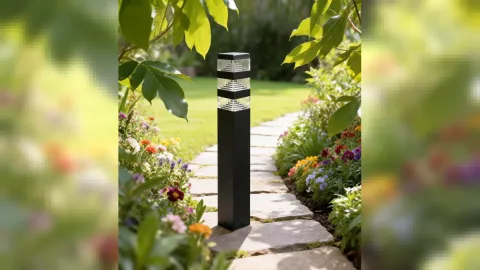
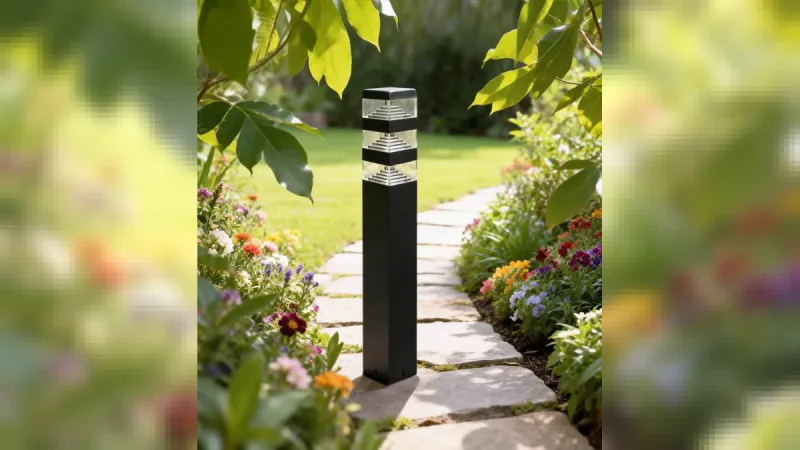
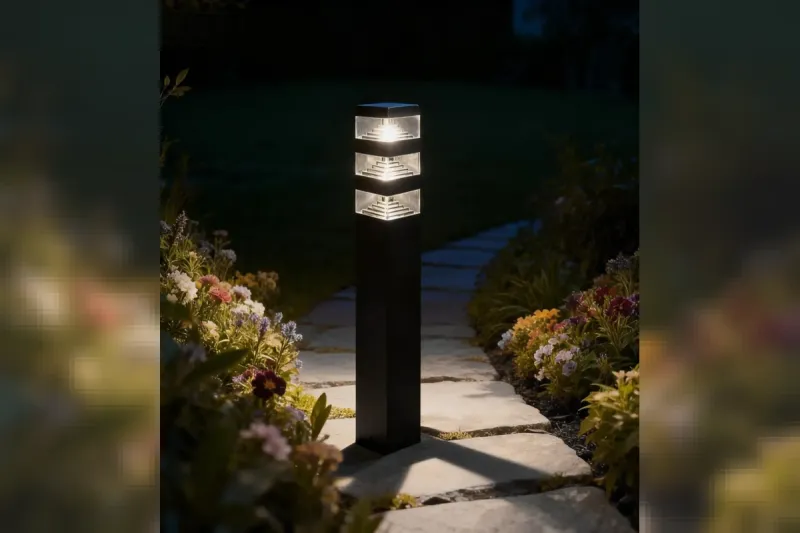
If a driveway, gate or entrance has to be lit every evening, all winter, wire it. The Pyramide 1500 is an 80 cm square bollard giving 1500 lumens of neutral white (4000 K) from 12 W, with a three-year guarantee. €79.90 on lumihome.com (Nov. 5, 2026). It runs on 230 V and must be earthed, so outdoor wiring and the connection should be done by an electrician, following the instructions and local rules.
Where it ships: Lumihome delivers to France, Belgium, Germany, Spain, Italy, the Netherlands and Portugal only. Not the UK, Ireland, Switzerland or anywhere outside the EU (as listed on lumihome.com on Nov. 5, 2026; check their site on the day).
Wired or solar for a driveway
| Pyramide 1500 (wired) | Solar bollard | |
|---|---|---|
| December evenings in northern Europe | Full brightness every night | Short bursts on motion, see GENOVA in winter |
| Installation | Trench, cable, electrician | Screw down or spike in |
| Running cost | About 26 kWh a year at 6 h a night | None |
| Parts that wear out | LEDs rated about 30,000 hours | Battery, typically every few winters |
| Guarantee | 3 years | 2 years, battery excluded |
At an assumed €0.20 to €0.25 per kWh, one bollard on for six hours a night costs about €5 to €7 a year. Put it on a dusk sensor or timer and it costs less.
What to agree with your electrician
- A dedicated outdoor circuit from the consumer unit, protected by a 30 mA residual-current device. In France this is covered by the NF C 15-100 wiring rules; your electrician will know the local equivalent elsewhere.
- Buried cable in a protective duct with a warning tape above it, so nobody digs through it later.
- Earth connected. This is a Class I fitting; the earth conductor is not optional.
- How it switches: a dusk-to-dawn photocell, a timer, or a switch by the door. Decide before the trench is closed.
- Spare duct. If you might add lights later, lay an extra duct now. Trenching twice costs more than the lights.
Things the spec sheet tells you
- The LEDs are not replaceable. On the smaller 1000-lumen Pyramide the head can be swapped; on this 80 cm model it cannot. At 30,000 hours that's well over a decade of evenings, but it is the end of the fitting when they go.
- EU energy class E. That sounds poor, but the energy label was rescaled in 2021 and most LED products now sit in the E to F range. What matters here is 12 W for 1500 lumens.
- IP44 and painted metal. Fine in rain; keep it away from the jet of a car-wash spot or a pressure washer. On the coast, rinse salt off now and then.
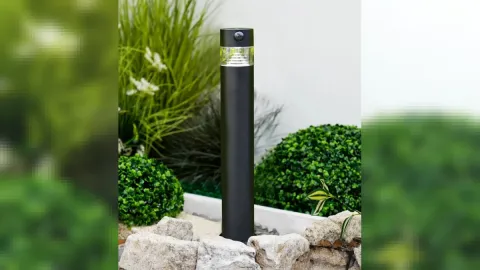
- 80 cm tall, 8 cm square. Tall enough to be seen from a car, which a 40 cm post isn't.
Who it suits, who it doesn't
Good fit: long drives, gates and parking areas; anyone renovating a garden and opening the ground anyway; homes in the Benelux, northern France and Germany where winter sun is scarce.
Pick something else if: you rent or can't dig (try GENOVA); the spot is far from any power supply; or you only want a soft marker light (see ORION).
Questions
Does it have a motion sensor?
No. Add a sensor or photocell on the circuit, or ask Lumihome about its sensor versions.
How far apart along a driveway?
At 1500 lumens and 80 cm, every 6 to 10 m gives clear guidance for a car; closer if pedestrians use the drive too.
Can I install it myself?
Fixing the bollard is simple. The 230 V outdoor connection should be done by a qualified electrician.
Does Lumihome deliver to the UK?
No. Only France, Belgium, Germany, Spain, Italy, the Netherlands and Portugal.
Specs and price checked on lumihome.com on Nov. 5, 2026. Running costs are estimated from the wattage; your electrician sets the wiring plan on site.